


Echoes of Coexistence: On the Former Spirit of Subotica
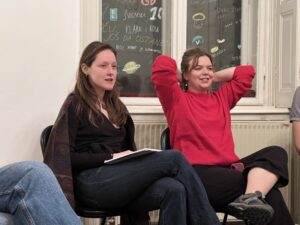
As part of the project “Echoes of Coexistence: The Intercultural and Multicultural Heritage of Subotica,” the civic cultural center Klara i Rosa organized an open circle dedicated to a particular layer of the city’s memory — the one that doesn’t live in official monographs, but in personal stories, lived experience, and atmosphere.
Project researchers Olga Čegar and Ivona Đurić opened the gathering with a simple but powerful question: What did the artistic and social life of Subotica once look like — not as decoration, not as a secessionist backdrop we proudly show to tourists, but as something woven into everyday life? As something that was truly lived.
Very quickly, it became clear that this was not only a conversation about the past. It was about values, ways of organizing, relationships to the city — and about what feels absent today.
Listening to the City’s Memory
.
People from different generations took part, and the meeting naturally became a space of exchange: younger participants listening to how the city once breathed, older ones feeling that their memories still have somewhere to land.
Former mayor Đerđ Sorad was mentioned, with some recalling the impact of his leadership. But more than individuals, the focus shifted to structure — to the importance of local community centers as spaces of encounter, creativity, and collective energy. These were places where things began.
Memories brought up “Majmun plac,” a symbol of informal gathering — meeting without spending much, without consumer logic. “We didn’t spend money in cafés; being together was enough,” one participant said.
Sports were practiced in the streets. A place in a club had to be earned. “You can’t really learn basketball in a club if you haven’t gone through the concrete,” someone added, pointing to the value of informal spaces alongside institutions.
There was investment in education. The economy was strong. The city felt grounded. Today, participants noted, we have infrastructure — courts, pools, facilities — but where are the young people? Where are the people?
Culture as Everyday Practice
.
When speaking about art, participants remembered art colonies, record shops that received the latest releases first, dance nights at the Jadran cinema, and a culture of going out in which dancing was part of basic social literacy.
Names and initiatives that shaped the city’s identity surfaced one after another: Professor Ema Horvat, who “infected” generations with poetry; musician Laura Levai, whose contribution, as noted, remains insufficiently recognized; artists such as Sombati Balint and Slavko Matković; events like the rock opera Zelenokosa and the Omladina festival. The founding of the summer cinema Nyári Mozi was also recalled — one of the rare initiatives that still exists — as an example of how new communal spaces emerged organically from shared need.
Throughout these stories ran a quiet but consistent thread: interculturality was not something that needed to be declared. It was simply lived through languages, collaborations, music, and everyday encounters. Artistic life was not confined to one institution; it functioned as a network of people, spaces, and initiatives strengthening one another.
KPGT, although a state project, was remembered as widely accepted and seen as a positive direction. Artists had space to express positions. Censorship was not experienced as ever-present. Society defined itself through music, ideas, and shared spaces.
Participants also noted that there were fewer rigid classifications, less competition, less constant measuring through profit. Today, much cultural life seems to depend almost entirely on individual enthusiasm.
Can Culture Exist Without Support?
.
One question lingered: can any serious cultural initiative survive without support from the city? And if not, why does the city not invest more consistently in its people? Why, as some participants phrased it, does funding sometimes flow toward “non-culture”?
Still, the conversation did not end in nostalgia.
Because what is culture, after all? The conclusion was nearly unanimous: culture is everything. It is whether we throw trash on the street, what time we gather for lunch, whether we walk along the Korzo or spend an evening at Palić. Culture is how we relate to space — and to one another.
Perhaps the most important sentence of the evening emerged in that spirit: no matter how much the past may sound like a fairy tale, the word “impossible” should be crossed out. The real question is always — what is possible?
This open circle was not simply a memory return. It was a reminder that the spirit of a city does not live in façades, but in people. And that avant-garde does not grow out of decoration, but from everyday life.
In that sense, the echoes of coexistence are not over. They are still unfolding.
Author: Anamarija Tumbas (UG Klara i Rosa)



.
BOOST is a regional project strengthening civil society in the Western Balkans by supporting youth, entrepreneurship, environmental protection, culture, and community development. It is implemented by Klara i Rosa and CK13 within a program coordinated by ALDA, with the support of the French Development Agency (AFD).
