


On Culture as the Connective Tissue of a Community
What happens when different actors within a local community come together and recognize culture as a key connecting force?
A space for encounter opens up. Trust begins to grow. A sense of belonging strengthens. Culture, as the connective tissue of a community, starts to bring people together precisely where differences and divisions are most pronounced.
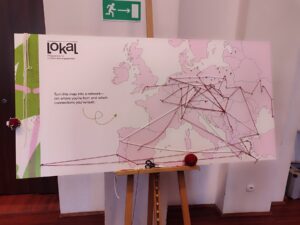
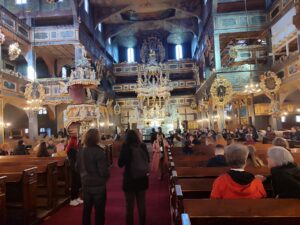
From April 21 to 24, 2026, participants from across Europe - primarily from Poland, Germany, and Ukraine (but also from Austria, the Czech Republic, Slovakia, Italy, Spain, Portugal, the Netherlands, Lithuania, Latvia, Greece, Croatia, Serbia, and Kosovo) - gathered in the Polish city of Świdnica for the first meeting of the European LOKAL network.
Klara i Rosa was the only organization representing Serbia. Over the course of four days, cultural workers and practitioners exchanged experiences, built new partnerships, and reflected on how their work can respond to increasingly visible social divisions, strengthen local networks, and sustain participation in communities where shared spaces are becoming ever more fragile.
As the mayor of Świdnica emphasized in her address, there are cities where culture is not a priority—something that is not only unfortunate, but dangerous. This is precisely why cultural policy carries the responsibility to institutionally support diverse voices. Her message was clear: social resilience begins with culture.
Olga Napiontek, whose work with Civis Fund Poland connects culture, education, and community, spoke about the importance of developing civic skills and attitudes that enable people to actively participate in public life. She stressed that today, it is more meaningful to work continuously with a community than to organize spectacular events and festivals. She draws a clear distinction: audiences come and go, but communities remain. A community feels, participates, and builds—it is the core of every local space. In a time of growing loneliness, where more and more people live alone, culture becomes a key space for encounter and connection. As she highlighted, social resilience is built precisely through art and culture.
I carry a number of unanswered questions with me. In the context of the rise of the far right and increasing radicalization, alongside worrying examples from Eastern Germany of growing neo-Nazi groups and violence, I hear colleagues say that the only response is to overpower that narrative with one equally strong, excluding the radical. Honestly, this saddens me. If everything comes down to who is stronger, where is the space for healing, for seeing oneself in the other, for connecting on a human level?
Another paradox that stays with me concerns the very role of culture. While the conference opened with inspiring speeches about its importance and diversity, the closing evening featured a performance by a folkloric group. Why is culture so often presented to outsiders exclusively through traditional folklore? Can we be more thoughtful in how we present the past through the lens of the present? Can folklore carry interpretations that speak to today, not just to yesterday? And ultimately, why is local culture so often reduced to inherited tradition, rather than understood as a living, contemporary practice of our fellow citizens today?
All of these themes resonate strongly in our own local context. Nowhere is perfect—everywhere we face similar challenges: radicalization, polarization, a lack of attention and interest among both young people and other social groups, as well as a digital space that increasingly replaces the physical, deepening feelings of alienation and loneliness. The key question remains: what kind of collaboration truly exists among local actors, and how willing are we to recognize each other as allies?
Reflecting on Subotica and the broader social context in Serbia, it is clear that culture lacks systemic support, and that cultural workers are largely left to rely on their own resources—a story told too many times, and one that no longer seems to interest anyone. Although investments are often mentioned, they are usually reduced to infrastructure, such as unfinished theater buildings, which mean little without the people and programs that bring them to life. Culture is not buildings—it is relationships between people, collaboration, trust, and openness to diversity. What is missing is continuous work with the community, which builds long-term relationships and a sense of belonging.
In times of division, the role of culture is to open space for dialogue. Even when it may seem that culture is not a priority, I feel that the task of cultural workers is to recognize the needs of the community and translate them into creative practices and collective action.
Upravo zato ovakvi susreti potvrđuju da, iako organizacije poput Klare i Rose dolaze iz manjih sredina, one aktivno učestvuju u savremenim evropskim kulturnim praksama i razmenama. Ovakve saradnje ne samo da povezuju aktere, već i doprinose vidljivosti lokalnih sredina u širem kontekstu. Istovremeno, ostaje važno pitanje u kojoj meri lokalni donosioci odluka prepoznaju ovaj rad i otvaraju prostor za saradnju – i kada će se konačno odustati od neformalnih „lista“ podobnih i nepodobnih. Bilo bi značajno da postoji veća povezanost sa savremenim praksama u Evropi i spremnost da se iz njih uči i na lokalnom nivou.
And finally, it is important to underline that social change is not the task of an individual or a single sector. It cannot come only from students, only from the IT community, or only from politicians. We need to step outside the boundaries of our own importance and shift our focus toward a shared goal—a social transformation in which we all take part.
Change happens when we act together.
Perhaps today, more than ever, we need more play, more exploration, and more mutual support—less fear of one another, and more shared creation.
LOKAL supports cultural organizations in smaller communities (up to 100,000 inhabitants) in building connections with diverse actors—from local businesses to civic initiatives—and in developing artistic projects rooted in everyday life. This gathering marks the beginning of a broader European exchange, where experiences are shared in order to strengthen connection and social cohesion. The LOKAL program was jointly initiated by Kulturstiftung des Bundes, the Federal Agency for Civic Education (bpb), and the European Cultural Foundation, in cooperation with the National Centre for Culture of Poland and the Świdnica Cultural Centre.
Author: Gordana Vukov Ciganjik