

OPEN CALL | We are looking for participants 22 STOPS in Subotica
We explore how we experience public space, how we move through it, how we avoid it, how we return to it, how we embody it, claim it, and remember it. Let us make visible the everyday routes and points in our city, practice seeing and being seen, being recognized, and collectively mapping the city across different generations, languages, and corners. Together, we will choose a series of “stops” across Subotica: courtyards, bus stops, street corners, places we often pass by but rarely notice, where stories and memories gather. Let us bring experimentation and mutual support into the public space!
At each stop, we will collectively create a simple action, a small instruction (score) that anyone can perform: movement or stillness, a gesture, a subtle dance shift, a short text, a whisper or singing, interaction with an everyday object, silence, or a choral expression. The focus is not on “performance skills,” but on presence and shared attention. Each stop becomes a shared trace, a living, collective memory in public space.
No previous experience in art or performance is required. Curiosity and care for the city are enough.
You can participate quietly by walking, observing, or proposing a stop, without pressure to “perform.”
Participation is free..
What we will do (March–July 2026)
March–June 2026
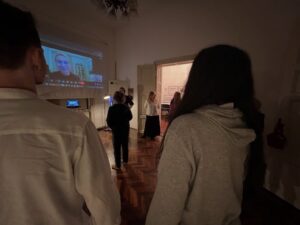
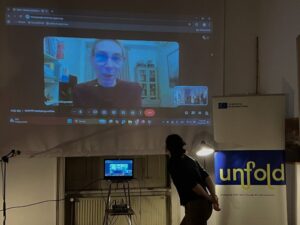
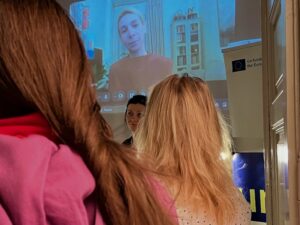
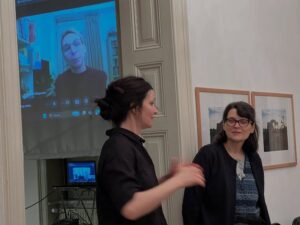
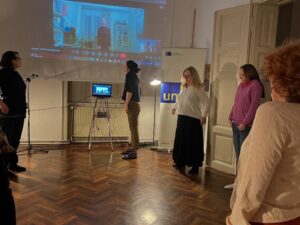
We will meet in the space of Klara i Rosa, while Katerina will lead online workshops (3 to 5 sessions) during which we build a shared language of embodied presence through simple exercises and accessible participatory scores.
The first meeting is on March 10 at 6 PM at Klara i Rosa..
June 28 – July 4, 2026 (when Katerina comes to Subotica) Four in-person workshops during which we will: identify and develop the stops, create the scores, shape the route, and prepare the collective walk.
Collective walk (July 2026)
We will visit the selected stops and activate the scores together as a gentle public intervention / collective action in the city.
Who is this for?
The call is for you if you:
- live, work, or study in Subotica (or feel strongly connected to it)
- have a place where you often stop (or that you avoid) and want to share why
želite da upoznate ljude različitih generacija, jezika i delova grada - want to meet people from different generations, languages, and parts of the city
You can participate in Serbian, Hungarian, Croatian, English, or any language you feel comfortable using.
The pace and format will be adapted to different bodies and abilities so that everyone can participate equally. The number of places is limited to preserve a careful and participatory process.
Before applying, consider whether you truly can, want to, and have the capacity to responsibly participate in the process and respect the time and dedication of the facilitator and the group. If more people apply, we will form a group that reflects the diversity of ages, languages, parts of the city, and relationships to the city.
Šta dobijate?
- The opportunity to co-create a route and become part of Subotica’s living memory in public space
- A set of participatory scores, simple poetic instructions you can use later
- A small shared project outcome: a simple map/route and a concise set of scores
- Participation in a unique collective act in a public space
How to apply?
Apply via form://forms.gle/Pz4aMpSqw42XEvuk7
Send an email to klarairosa@gmail.com with:
your name and contact information
1–3 “stops” you would like to propose
any accessibility needs (walking pace, mobility, etc.)
We look forward to seeing and experiencing the city together in different ways.
The project is co-funded by the European Union and implemented by the organizations “Klara i Rosa” (Serbia), “Iminente” (Portugal), and “Balkan Beyond Borders” (Greece). The views and opinions expressed are those of the authors and do not necessarily reflect those of the European Union or the European Education and Culture Executive Agency (EACEA). Neither the European Union nor EACEA can be held responsible for them.